
Treating your customers well and giving them an occasional gift is not just courtesy: it is profitable. Here is what Harvard and MIT research says, and how to apply it in your business.
There is a widespread idea that taking care of customers and, every once in a while, giving them something is simple courtesy: the "right thing to do", but with no measurable impact on the business. The evidence says the opposite. Treating people well and giving them, from time to time, something for free is not a soft expense or a sentimental concession: it is one of the most well-documented profitability levers that exist.
In this article we walk through three pieces of research —two of them from Harvard and MIT— that explain why customer experience translates into money, why a small free gift activates a powerful norm of reciprocity, and why the word "free" weighs much more than it costs. And, above all, how to apply it in a real business.
Treating customers well is not being nice: it is profitable
For years, the value of customer experience was considered something subjective, impossible to quantify. That changed with Peter Kriss's research published in Harvard Business Review in 2014, "The Value of Customer Experience, Quantified".
The team analyzed two companies with revenue over one billion dollars —one transactional and one subscription— and measured the relationship between the experience customers had and how much they spent afterwards. The result was striking:
- Customers who had the best experiences spent 140% more than those who had poor experiences.
- In the subscription business, a better experience was directly associated with higher retention and lower churn —and, at the same time, with a lower cost to serve those customers.
In other words: quality of treatment does not only "feel good", it predicts how much a person will spend again and how long they will stay with you.
This aligns with a classic profitability principle: retaining is cheaper than acquiring. According to Bain & Company, increasing customer retention by just 5% can boost profits very significantly, because acquiring a new customer costs several times more than keeping an existing one, and loyal customers tend to spend more over time. Good treatment is, in practice, an investment with one of the best returns available.
The power of a free gift: the principle of reciprocity
If treating customers well pays off, what happens when you also give them something they did not expect? Here enters one of the deepest norms of human behavior: reciprocity. When someone gives us something, we feel an almost automatic urge to return the gesture.
The experiment that best demonstrates this is surprisingly simple. Strohmetz and his colleagues (2002), in the study "Sweetening the Till", measured what happened when restaurant waiters delivered a piece of candy along with the bill:
- One candy per diner increased tips by about 3%.
- Two candies increased them by around 14%.
- And the most revealing case: when the waiter left a candy, turned to leave, then came back saying "for you, because you are so nice, an extra candy", tips rose by up to 23%.
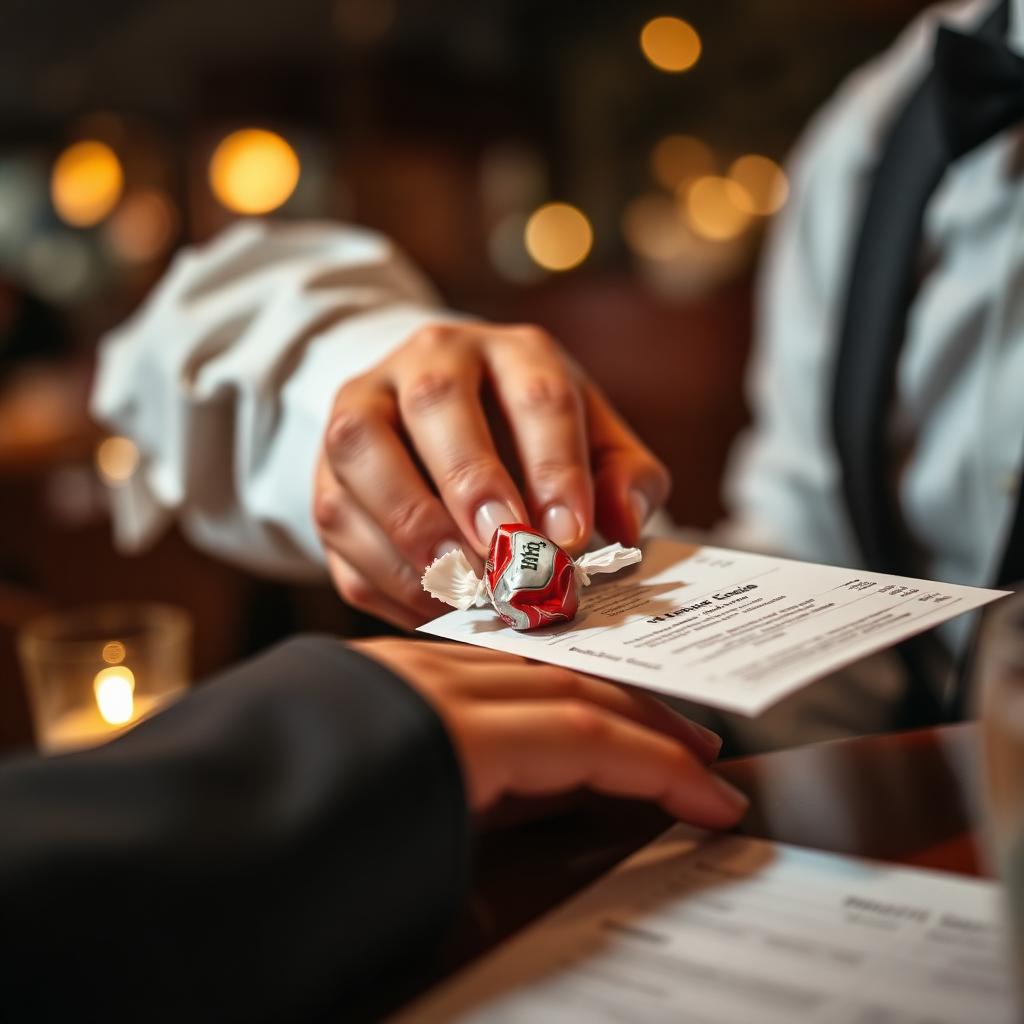
Notice the detail: what triggered the effect was not the amount of candy, but that the gesture felt personal and unexpected. The authors concluded that the explanation is not just the "good mood" a sweet creates, but reciprocity: the customer perceives a favor and feels the need to return it. A tiny gift —worth cents— produced a disproportionate return.
Why "free" weighs more than it costs: the zero-price effect
There is a third piece, equally counterintuitive. It turns out zero is not just any price: it has an emotional force of its own. This was demonstrated by the behavior studied by Shampanier, Mazar and Ariely in "Zero as a Special Price: The True Value of Free Products" (2007), with an experiment set up on the MIT campus.
They set up a chocolate stand with two options: Lindt truffles (premium) at 15 cents and Hershey's Kisses (regular) at 1 cent. As expected, 73% chose the Lindt, clearly superior and still cheap.
Then they repeated the experiment lowering both prices by exactly 1 cent: the Lindt was 14 cents and the Hershey's… free. The price difference between them was identical to the first case. And yet, demand flipped completely: 69% chose the free Hershey's, giving up the better chocolate.
"Free" is not processed as "very cheap". It triggers an emotional response that makes us overvalue what we receive and remove the perception of risk.
The conclusion is key for any business: that is why a gift or a free sample can have an impact on a customer's decision far greater than its real cost to you.
How to apply it in your business
These three pieces of research converge on a concrete strategy, especially useful in services and B2B, where long-term relationships are everything:
- Make good treatment a standard, not an exception. Experience is not just the product: it is every interaction, from the first response to after-sales. Train the team to be attentive and resolutive in a consistent way, because that consistency is what translates into more spending and retention.
- Deliver value for free, upfront. A sample, a free initial audit, a diagnostic, a free trial, a useful resource. In B2B, a "gift" can be knowledge: a mini-report, an honest recommendation, or an hour of advice. Whoever receives genuine value feels the urge to reciprocate.
- Personalize the gesture. The extra-candy experiment makes it clear: the same gift performs much better when it feels personal and unexpected. A detail aimed at that specific customer is worth more than a generic benefit identical for everyone.
- Use the power of "free". A no-cost add-on —free shipping, an extra month, an included extra— often moves the decision more than an equivalent discount. Zero has a power that "almost free" does not.
- Measure experience. What does not get measured does not improve. Regular satisfaction surveys and loyalty metrics (like NPS) let you detect friction, reduce churn, and lower cost to serve, just as HBR's research shows.
The balance: when free does NOT work
An important nuance: reciprocity and the power of free work when the gesture is perceived as genuine and relevant. A token detail against a huge invoice can feel insignificant —or worse, calculated— and produce the opposite effect. The gift does not replace bad service or buy a bad experience. It is an amplifier: it boosts a relationship that is already cared for, it does not save one that is neglected.
Loyalty is not built with a single gesture either, but with consistency over time. Sustained good treatment is the foundation; the unexpected free detail is the accelerator.
Conclusion
Treating your customers well and, every now and then, giving them something they did not expect is not sentimentality: it is one of the most evidence-backed commercial decisions out there. Harvard quantified that good experience makes people spend up to 140% more and stay longer. Research on reciprocity showed that a gift worth cents can raise what the customer returns by up to 23%. And MIT proved that the word "free" moves decisions far beyond its cost.
In markets where product and price look more and more alike, treatment —and small genuine gestures— is often the only thing that truly sets you apart.
Frequently asked questions
Why does giving something to your customers actually work?
Because of the principle of reciprocity: when a person receives an unexpected gift, they feel the urge to return it. In Strohmetz's study (2002), a simple candy with the bill increased tips between 3% and 23%, depending on how it was delivered.
How much more do customers spend with a good experience?
According to Harvard Business Review research (Peter Kriss, 2014), customers with the best experiences spent up to 140% more than those with poor experiences, and they also stayed longer.
Is a discount better than something free?
Often, something free. The "zero-price effect" demonstrated by Shampanier, Mazar and Ariely at MIT (2007) shows that the word "free" has an emotional force that an equivalent discount does not achieve: it makes us overvalue what we receive and remove the perception of risk.
Does this work in B2B and service businesses?
Yes. In B2B the "gift" is usually value delivered upfront: an initial audit, a diagnostic, a trial, or an honest recommendation. It generates reciprocity and builds the long-term relationship on which loyalty is based.
Sources
- Kriss, P. (2014). The Value of Customer Experience, Quantified. Harvard Business Review. https://hbr.org/2014/08/the-value-of-customer-experience-quantified
- Shampanier, K., Mazar, N. & Ariely, D. (2007). Zero as a Special Price: The True Value of Free Products. Marketing Science, 26(6), 742–757.
- Strohmetz, D. B., Rind, B., Fisher, R. & Lynn, M. (2002). Sweetening the Till: The Use of Candy to Increase Restaurant Tipping. Journal of Applied Social Psychology, 32(2), 300–309.